
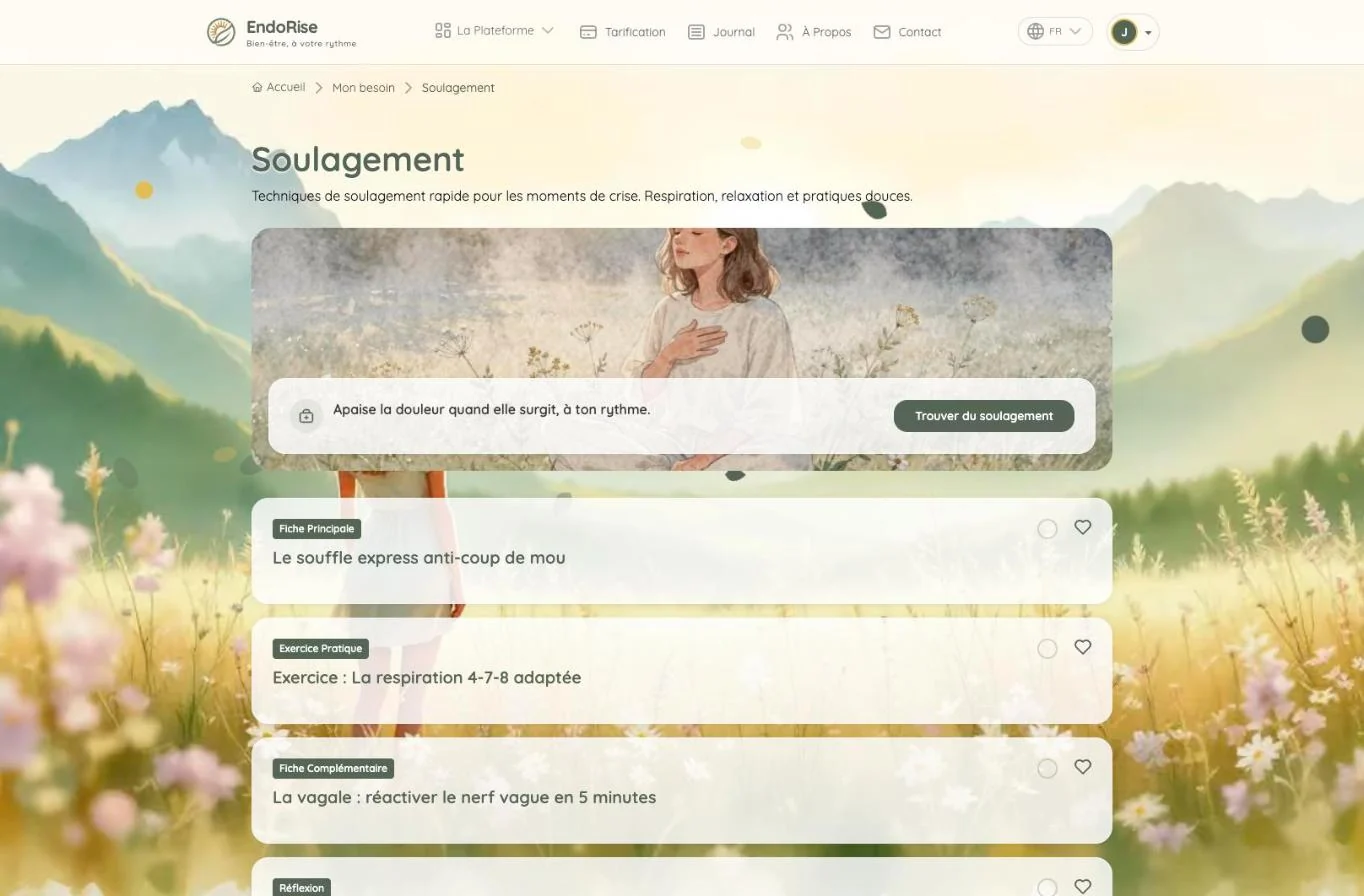
Programmes across two paths — Need and Desire
// Wellness platformCS.01
EndoRiseendorise.fr
From an awareness page to a science-backed platform — adaptive pathways, subscription billing, and an AI assistant.
EndoRise had a simple page explaining endometriosis. We rebuilt it into a science-backed wellness platform — two adaptive pathways, evidence sourced from INSERM and Cochrane, subscription billing, and an AI-powered assistant. A platform worthy of the 190 million women who need it.
// The build
Inside the member area.
Real screens from the live platform, signed in as a member.
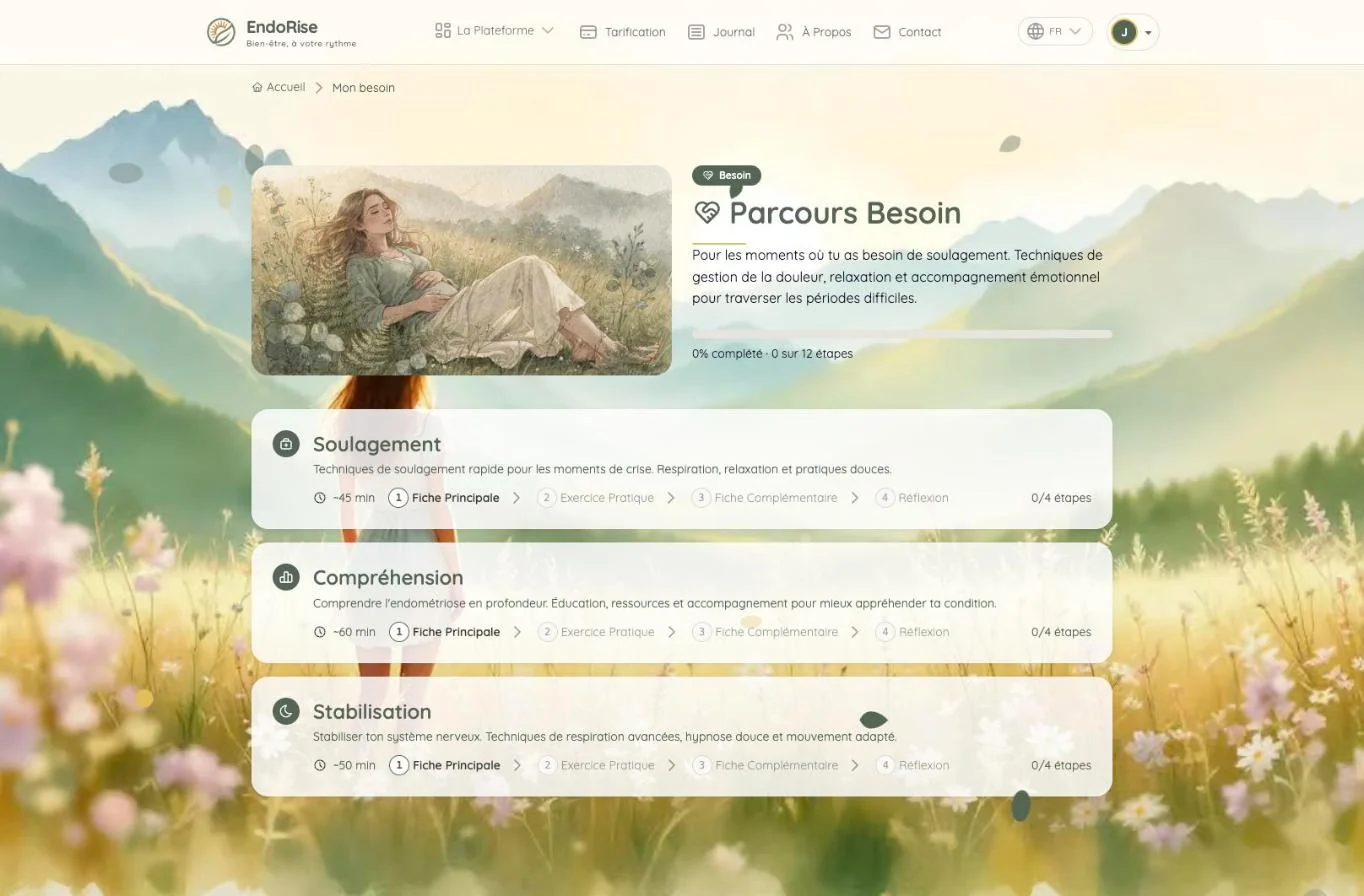
01 The Need pathRelief, Understanding, Stabilisation — three programmes for the hard days.
Google's test, verified liveVerified on 9 Oct 2026
96Mobile
100Desktop
97Mobile
97Desktop
100Mobile
100Desktop
100Mobile
100Desktop


// Audited, rebuilt, verified
Ten audits, before and after
A dated delivery record: audited April 2026, rebuilt, then re-scored on the live site. The six in-depth checks lead; the eight scores from Google's own test — four areas on mobile and desktop — are verified live.
In-depth checks — before → after
Content quality9296+4Audited April 2026
Your content scores 94. The platform carries genuine editorial depth — a 24-reference bibliography, eight dated blog articles, cited INSERM and HAS/CNGOF anchors, a visible verification date and a named clinical team. Structure is clean — one H1 per page, unique page descriptions, and structured data. A few consistency refinements remain worth chasing: aligning the formal and informal address across pages, settling on one label for the Besoin/Désir pathway, and standardising the non-drug therapy acronym.
Key findings
- Your evidence layer is genuinely strong: INSERM/Nnoaham/Touboul/Özdemir citations, a “verified 2 June 2026” stamp, HAS/CNGOF references and a 24-reference bibliography.
- Clean information architecture: a seven-item menu maps one-to-one to pages, single H1s, unique page descriptions and six structured-data blocks on the homepage.
- Register mixing on public pages: the pricing FAQ and one plan bullet in the informal “tu”, a “Prête à transformer ton bien-être ?” heading over a formal “vous” body, the about-page story in “tu” (29 “tu” strings vs 150 “vous”).
Recommendations
- Unify the address register: the formal “vous” on all public marketing pages, the informal “tu” reserved for the logged-in app — fix the pricing FAQ, plan bullets and about-page story first.
- Lock terminology sitewide: Besoin/Envie as the only pathway pair and one acronym (TNM) for non-drug therapies, then sweep the homepage, comparison table and foundations page.
Look and style7484+10Audited April 2026
Both flags from the 2 June check are fixed. Raw hardcoded colours in inline styles went from 27–80 per page to zero across all seven pages crawled — every colour now routes through your design tokens. The duplicate sage is resolved: a single sage value (#556654) defines the green everywhere, and the old #4A7C59 returns zero hits in both the HTML and the 85KB stylesheet. Playfair Display and Quicksand are self-hosted and load without blocking the page. Measured contrast passes the AA standard on all primary text pairings; gold used as link text on light backgrounds (1.79:1) is the one genuine failure left.
Key findings
- Hardcoded colours in inline styles eliminated: 27–80 per page on 2 June, now 0 raw colour values across all 7 pages — every inline colour routes through your design tokens.
- Duplicate sage resolved: a single sage value (#556654) defines the green everywhere; the old #4A7C59 returns zero hits in the served HTML and the stylesheet.
- A two-layer token architecture with meaning-based aliases (status, surface, per-pathway icon tokens) and a Tailwind bridge drawing on the same colour values.
Recommendations
- Fix the gold-on-light text contrast: darken the link gold to around #8a6d1f, or switch article links and the hover state to sage (6.15:1 on white).
- Adopt the corner-radius tokens everywhere: replace raw 20px, 24px and other one-off values with the radius tokens, and add a larger radius token if 24px is intentional.
Marketing effectiveness7889+11Audited April 2026
Your rebuilt site scores 90 on marketing effectiveness, up from 45. The funnel reads clearly: the hero names its audience, every page closes on a no-card 7-day trial, pricing anchors three tiers with a 30-day guarantee and a five-question FAQ, and a 10-feature comparison sets EndoRise apart from generic wellness apps. A few refinements remain worth chasing — aligning the trial description between the contact FAQ and the pricing page, sourcing the headline proof numbers (94% recommendation rate, 15+ therapists, 200+ sessions), and giving the testimonials fuller attribution.
Key findings
- The top of the page answers who and what: an audience-specific subtitle under 'Reprenez le contrôle de votre bien-être' with a dual call to action, backed by a sourced four-stat evidence band.
- Friction is handled across the site: a no-card 7-day trial button on every page, a 30-day money-back guarantee, Stripe named, and a one-step route to sign-up.
- Differentiation is explicit: a 10-feature comparison against generic wellness apps, information sites and inaction, plus a dedicated evidence page.
Recommendations
- Reconcile the trial promise: one sentence defining exactly what the 7-day trial includes, used identically on the pricing page, the contact FAQ and the hero.
- Source or replace the proof numbers: add sample size and survey date to the 94% claim, reconcile '15+ therapists' with the five named practitioners, and date the 200+ sessions count.
Security posture8191+10Audited April 2026
Your rebuilt site scores 96 on security, up from 30 on the old site. The Content-Security-Policy is confirmed working live — it blocked an external script injection mid-audit — and it sits alongside a comprehensive set of headers: two-year preloaded HSTS, frame protection set to deny, content-type sniffing off, a strict referrer policy, a permissions policy that locks down camera, microphone, location and payment, and same-origin isolation. Everything is served over HTTPS and all assets resolve to Supabase. The policy has been hardened since the last audit — eval execution is now removed; only inline execution remains, which Next.js requires to load the page.
Key findings
- Security scores 96 out of 100, up from 30 on the old site.
- The Content-Security-Policy is active and restrictive — it was confirmed live by blocking an external script during the audit.
- HSTS runs for two years with preload, framing is denied, content-type sniffing is off, the referrer policy is strict, and the permissions policy locks down camera, microphone, location and payment.
Recommendations
- Move to a nonce-based Content-Security-Policy via the Next.js middleware to drop the remaining inline execution — eval is already removed. Test that the page still loads.
- Confirm the full header set live with a security-header checker before launch.
AI search readiness9799+2Audited April 2026
Your rebuilt site is unusually well prepared for AI answer engines. Every page serves fully rendered French HTML, the homepage carries a clear “Qu'est-ce qu'EndoRise ?” block with a speakable spec pointing straight at it, and the stat band cites the WHO, INSERM and named studies under a “verified 2 June 2026” stamp. An llms.txt file, a clean robots.txt, a sitemap and unique per-page descriptions guide crawlers, and the structured data covers your organisation, the site, your medical pages, the FAQ and blog posts. A few small gaps remain: duplicate schema blocks, three leaked translation keys, an English version with no crawlable address, and blog articles that assert science without naming their sources.
Key findings
- An llms.txt file is present and well-formed: an English overview, nine key pages with descriptions, and explicit audience and language notes — a direct map for AI crawlers.
- Your medical-page schema names the condition “Endométriose” with an audience and a speakable block targeting the homepage answer — entity clarity engines can resolve directly.
- The homepage stat band cites named sources (WHO 2025, INSERM cohort, Nnoaham et al. 2011) under an “Informations vérifiées le 2 juin 2026” stamp, with a medical disclaimer — quotable, dated, attributed claims.
Recommendations
- Emit each schema block exactly once per page (the FAQ on the pricing page, the breadcrumb on articles).
- Seed the three missing text keys (the skip-link label and the two service titles) so no template internals show in the visible text.
Google's own test — verified live
Perf96Verified live
Access97Verified live
Found on Google100Verified live
Best pr.100Verified live
// By the numbers
From awareness page to platform
Steps in every programme: guide, practice, deeper reading, reflection
From brief to live
// What we built
Beyond a website
Member logins
Secure sign-in, personal dashboards, and role-based access for customers, members, or learners.
Course & content platform
Video lessons, downloadable resources, progress tracking, and structured pathways — not just pages.
Payments & subscriptions
Stripe-powered one-off purchases, recurring billing, free trials, and tiered pricing — wired in and tested.
AI built in
AI-powered assistants, coaches, and recommendations — real intelligence inside the product.
Native mobile apps
iOS and Android apps that sync with the web platform — your product in every pocket.
Database & connections
Organised data, live look-ups and links to other tools — the backbone that turns a site into a product.
// The results
What changed
- Six non-drug programs built on INSERM and Cochrane evidence, each one in four steps a member can follow at her own pace.
- The full digital presence rebuilt and live in four weeks.
- Favourites, progress tracking, a 123-term glossary, subscription billing and an AI-powered assistant — a platform, not a brochure.
We had a simple site explaining endometriosis. PostAgency rebuilt it into a real platform — two adaptive wellness pathways, evidence-based programs sourced from INSERM and Cochrane, free trials, subscription billing, and an AI assistant. A platform worthy of the 190 million women who need it.
Jonathan Rouet · Founder, EndoRise
// More builds
See the other two
// INPUT REQUIRED